


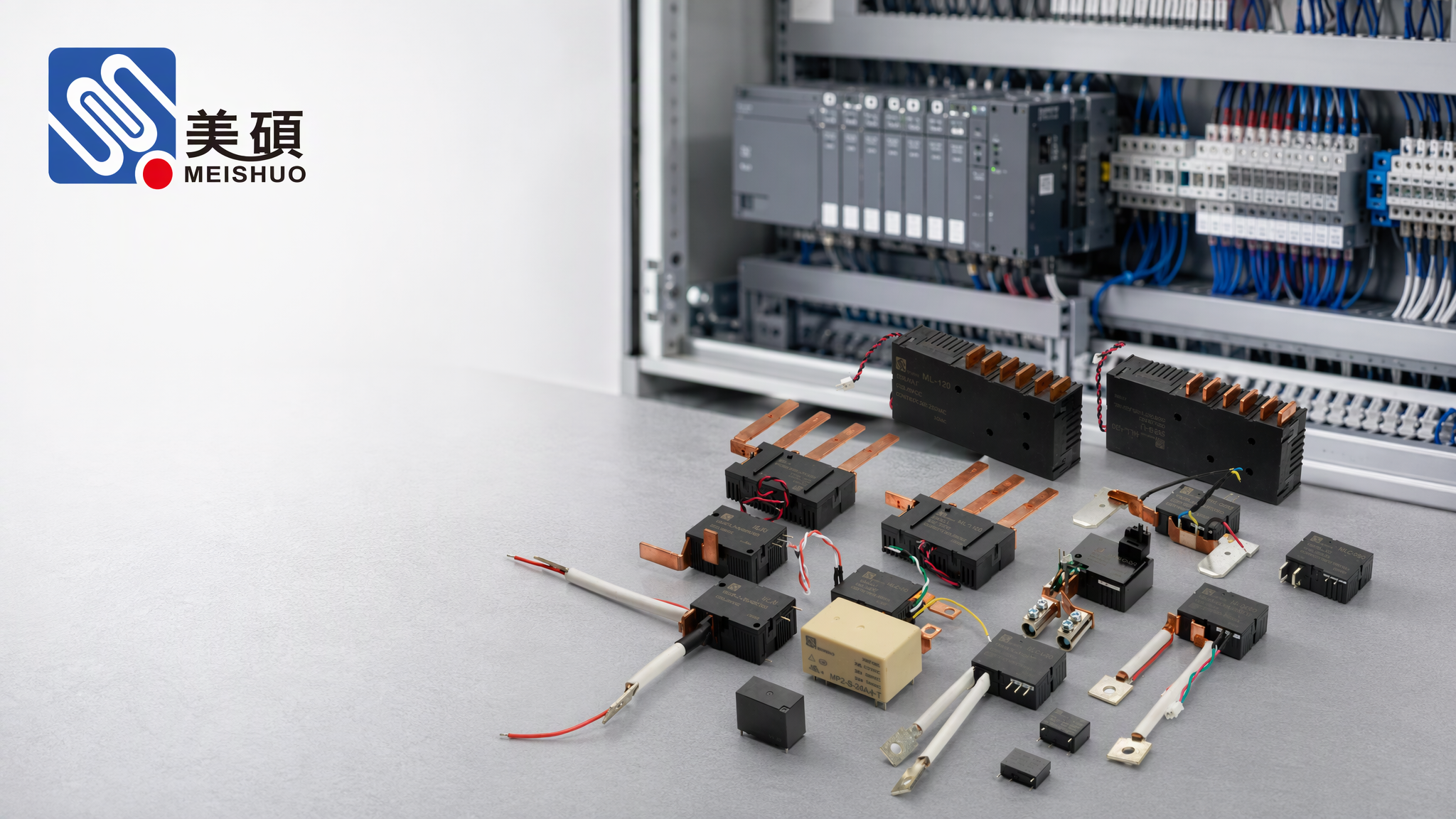
 Why modular automation relay integration matters in 2026
Modular automation relay integration is moving from a component-level discussion to a broader control-panel design decision. Industrial automation platforms are adding more connectivity, distributed I/O, integrated safety functions and cybersecurity requirements. At the same time, control-panel builders must continue to manage wiring clarity, service access, machine-load switching and production consistency.
Recent public industry coverage reflects this direction. Control.com’s PLC news category continues to track developments in programmable-control systems and automation applications. A Rockwell Automation announcement indexed in current search results describes an updated controller platform with performance, integrated safety and cybersecurity capabilities. Phoenix Contact describes PLCnext Technology as an open automation ecosystem combining modular hardware, software and a digital market. These sources show the direction of industrial control architecture; they do not establish any specific relay product rating or performance claim.
For relay suppliers and control-panel engineers, the implication is practical: the relay interface must be planned around the controller, load, wiring, protection and maintenance workflow. A relay that is electrically suitable but difficult to identify, wire or replace can still reduce the value of a modular control architecture.
Before selecting an interface relay, define the machine action it supports. A relay may switch an actuator, isolate a field circuit, pass a controller output to a load, or provide a service boundary between control logic and machine wiring. Each role has different implications for contact arrangement, switching frequency, wiring, diagnostics and replacement.
During the design review, document the machine function, normal state, fault state, controller signal, load type and service action for each relay position. This creates a common reference for electrical design, panel assembly, software commissioning and supplier communication.
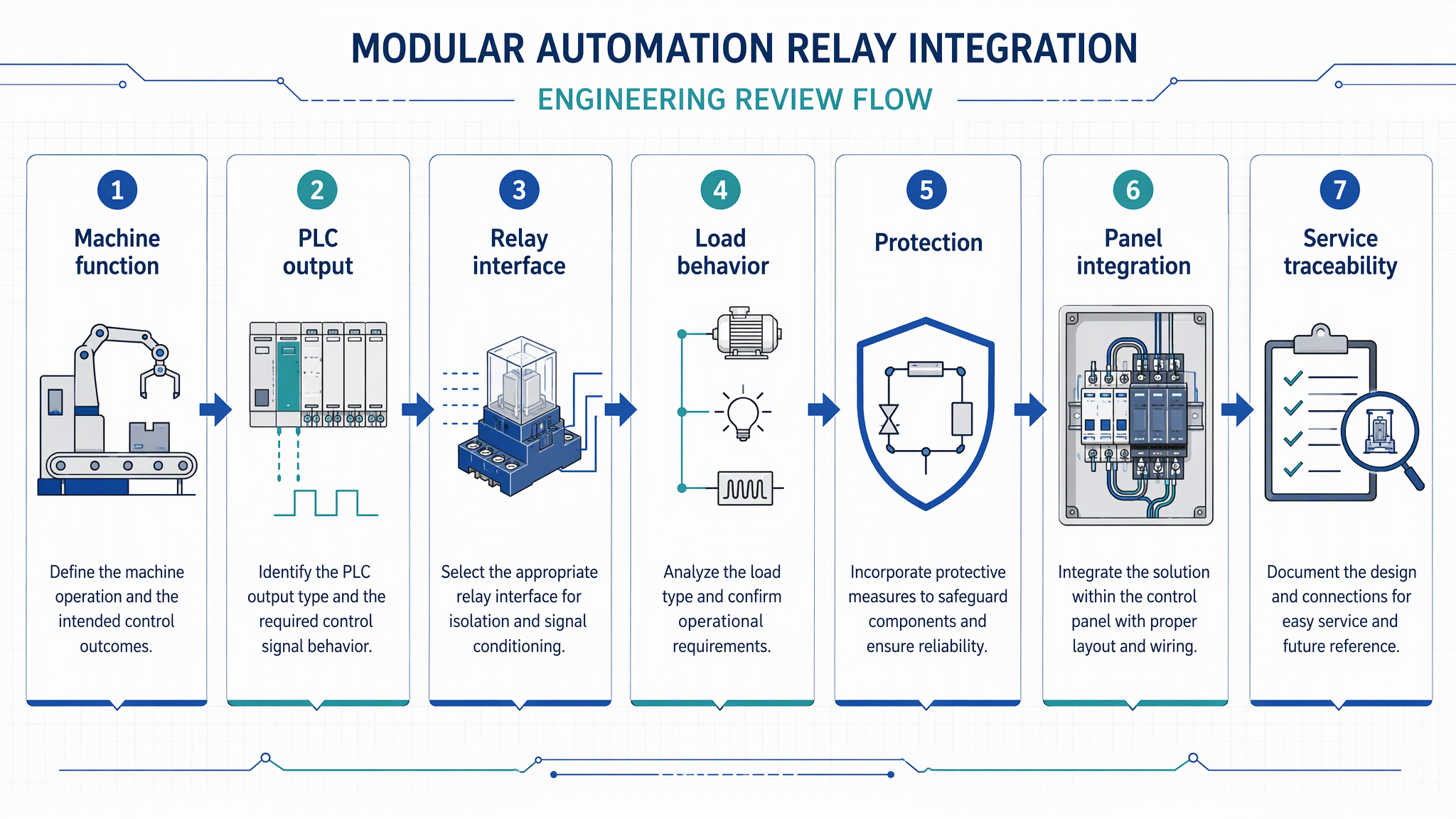
Modular automation relay integration decision path for industrial control panels
A PLC output belongs to the control side of the system. The machine load belongs to the field side. The relay interface connects these two domains, but it should not be treated as a simple wire extension.
Review the controller output characteristics, the relay input or coil requirements, the field-load behavior and the required isolation. This is especially important when a standardized control platform is used across machines with different actuators, valves, motors, heaters or signaling circuits.
A clear interface definition helps prevent late changes to PLC output modules, terminal layouts or panel wiring. It also makes it easier to compare relay alternatives without losing sight of the machine function.
Load classification should be part of relay selection. Resistive, inductive and motor-related loads can impose different switching conditions. Startup behavior, suppression, switching frequency and the required contact arrangement should be reviewed in the application context rather than inferred from the relay’s appearance.
The design record should identify the load category, normal switching pattern, expected abnormal condition and any external suppression or protection. If these conditions are not yet confirmed, the correct action is to mark them as open engineering inputs rather than publish an unsupported rating.
A modular panel is easier to commission when the boundary between logic, interface and field wiring is visually and electrically clear. Relay placement, terminal grouping, wire routing and protective devices should support this separation.
The panel review should consider:
• Which circuits require isolation between controller and field wiring
• Where protective components are located
• How common and switched conductors are identified
• Whether service personnel can trace a circuit without removing unrelated parts
• How changes are documented between prototype and production panel
This does not mean every control cabinet needs the same physical layout. It means the layout should make the intended system boundary understandable.
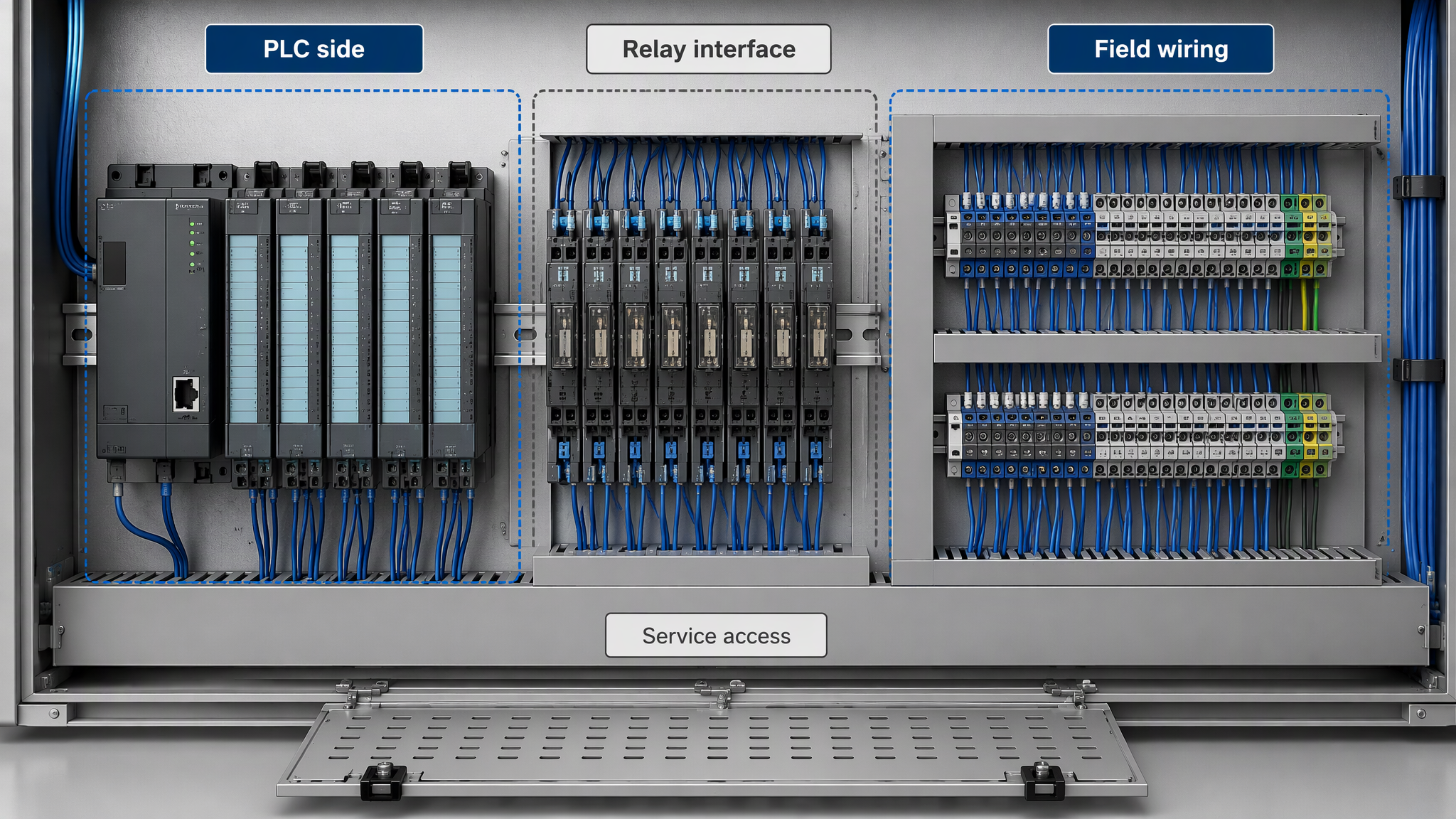
Industrial relay integration between PLC modules, terminal blocks and field wiring
A modular electrical diagram does not automatically create a modular manufacturing process. The relay interface, terminal blocks, wire ducts and mounting components should be arranged so that assembly, inspection and replacement follow a repeatable sequence.
Consider the access direction, tool clearance, wire labeling, terminal grouping, spare capacity and the ability to replace a relay without disturbing neighboring circuits. When the same panel family is adapted for different machine variants, define which positions are fixed and which are configurable.
This approach can improve communication between engineering, purchasing and production because each team can see how the interface is intended to be assembled and maintained.
Modern automation discussions increasingly include industrial connectivity, edge data and the ability to connect legacy assets with newer control systems. The relay itself may remain a physical switching component, but its role in the system should be documented in a way that supports commissioning and troubleshooting.
Record the relay position, connected load, controller address or channel reference where applicable, terminal identifiers and revision history. These records allow technicians to connect an observed machine behavior with the physical interface and the control logic.
The goal is not to claim that a relay independently provides cloud connectivity or predictive analytics. The goal is to make the physical switching layer understandable within a more connected automation system.
Relay integration must account for the actual control-panel environment. Heat from adjacent components, enclosure density, airflow, dust, vibration, wiring bundles and installation orientation can all affect the design review.
Use the verified relay documentation and the intended panel conditions to define the applicable boundaries. Validate the assembled panel rather than assuming that a relay tested in isolation represents the final cabinet condition. A disciplined review should also confirm that the chosen relay arrangement does not block ventilation, inspection or replacement access.
Serviceability is one of the strongest practical benefits of a well-designed modular panel. A technician should be able to identify the relay, understand its circuit role, confirm the associated terminals and replace it using controlled documentation.
A useful service record can connect:
• Panel and machine variant
• Relay position and part reference
• Wiring or terminal identifiers
• Inspection and replacement event
• Relevant test or commissioning record
• Approved revision and supplier document
This information helps reduce the risk of replacing a visually similar component without checking its electrical and mechanical suitability.
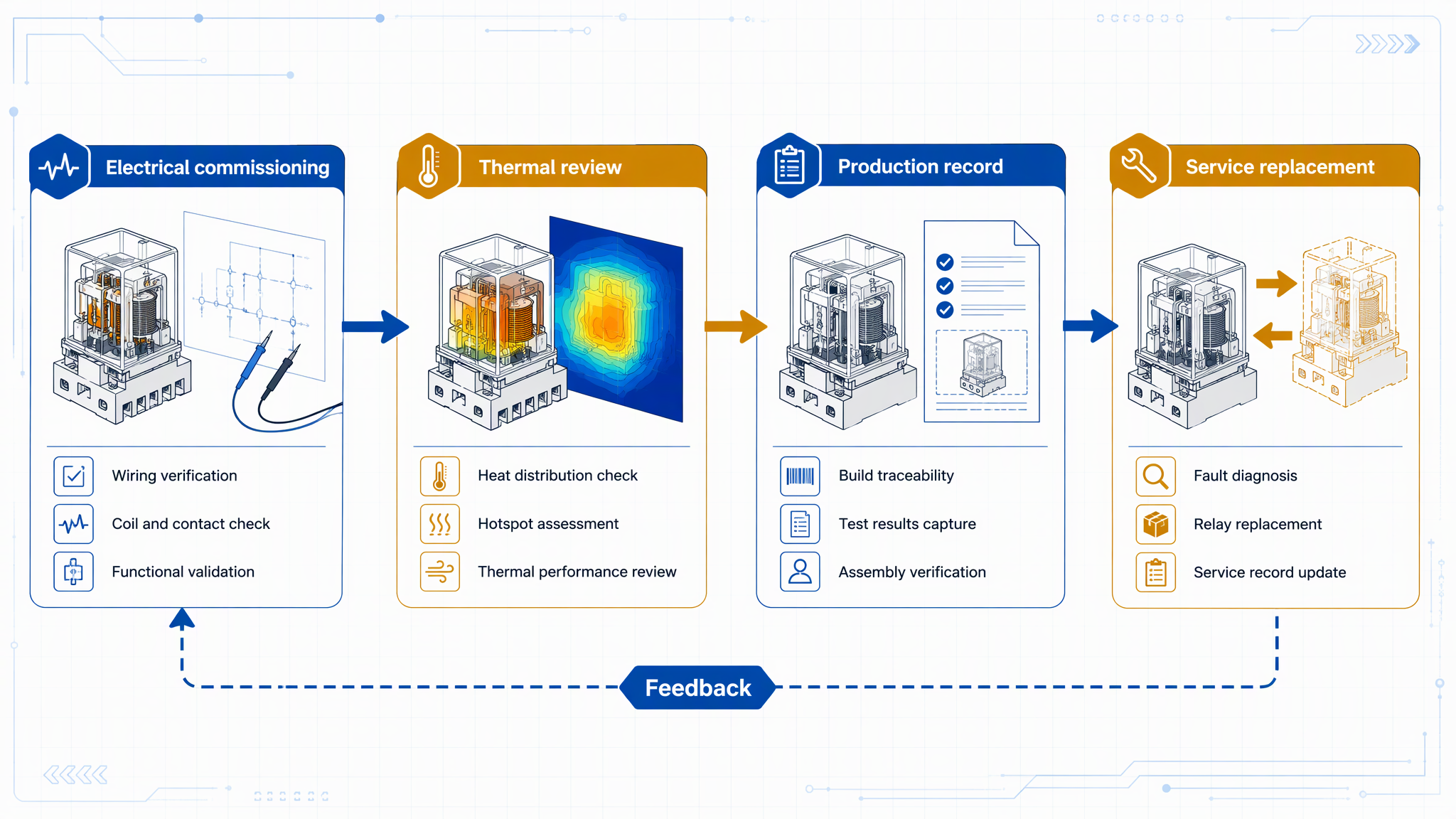 Modular automation relay validation and service traceability workflow
Before releasing a modular automation panel to production, review these questions:
1. Is the machine function of each relay position documented?
2. Are PLC output conditions and field-load behavior evaluated together?
3. Are isolation and protection boundaries visible in the panel design?
4. Can the relay interface be assembled, inspected and replaced consistently?
5. Are relay positions and wiring references linked to commissioning records?
6. Have thermal and environmental conditions been reviewed inside the enclosure?
7. Are part revisions, supplier documents and service events traceable?
This checklist supports engineering communication. It does not replace a product datasheet review, application validation, electrical safety assessment or any applicable compliance process.
A relay supplier can support modular automation projects by providing clear interface information, controlled product documentation, application boundaries and consistent revision communication. Early involvement is especially useful when the control-panel architecture is being standardized across multiple machine variants.
For Meishuo, the relay interface is part of a larger engineering conversation that includes controller compatibility, field-load switching, cabinet integration and service planning. The objective is to help OEMs and system integrators make a documented component decision that fits the complete control system rather than selecting a relay from a single isolated number.
Contact the Meishuo engineering team to discuss an industrial relay interface brief, control-panel layout requirement or application-validation plan.
• Control.com, PLCs Automation & Control Engineering News
• Rockwell Automation, Advances Integrated Architecture Portfolio with CompactLogix 5390 Controller
• Phoenix Contact, PLCnext Technology

 Chat Oline
Welcome to www.msrelay.com (the "Site"), operated by Meishuo Electric ("Meishuo", "we", "us"). We respect your privacy and are committed to protecting the personal information you share with us. This Privacy & Cookie Policy explains what information we collect, how we use it, and the choices you have.
Information you provide: when you submit an inquiry or contact form, we collect your name, email address, phone number, country, and the content of your message, so that we can respond to your request and provide quotations or technical support.
Information collected automatically: when you browse the Site, we may automatically collect standard technical data such as your IP address, browser type and version, device type, pages visited, and time spent on pages. This data is used in aggregated form only.
The Site uses cookies and similar technologies for the following purposes:
• Essential cookies – required for the Site to function (for example, remembering your language preference or that you have dismissed the cookie notice).
• Analytics/performance cookies – help us understand how visitors use the Site so that we can improve its content and structure. These are only set with your consent.
You can accept or reject non-essential cookies via the cookie banner shown on your first visit. You may also delete or block cookies at any time through your browser settings; please note that disabling essential cookies may affect the functionality of the Site.
We use the information we collect to: respond to inquiries and provide customer support; process quotation and sample requests; improve and optimize the Site; ensure the security of the Site; and comply with legal obligations. We do not sell, rent, or trade your personal information to third parties for their marketing purposes.
We may share your information only with: service providers who help us operate the Site and our business (for example, website hosting and email delivery services), bound by confidentiality obligations; or where required by law, regulation, or legal process.
We take reasonable technical and organizational measures to protect your personal information against unauthorized access, loss, or alteration. Inquiry data submitted through the Site is transmitted to and stored on servers managed for our business use only.
Depending on your location, you may have the right to request access to, correction of, or deletion of your personal information held by us, and to object to or restrict certain processing. To exercise these rights, please contact us using the details below.
The Site may contain links to third-party websites. We are not responsible for the privacy practices or content of those websites, and we encourage you to review their privacy policies.
We may update this Privacy & Cookie Policy from time to time. The current version is always available on this page, and the "Last updated" date below reflects the most recent revision.
If you have any questions about this Privacy & Cookie Policy or our handling of your personal information, please contact us:
Meishuo Electric
Email: ms@msrelay.com
Phone/WhatsApp: +86-18357779662
Address: Wenzhou, Zhejiang, P.R. China
Last updated: November 12, 2026